

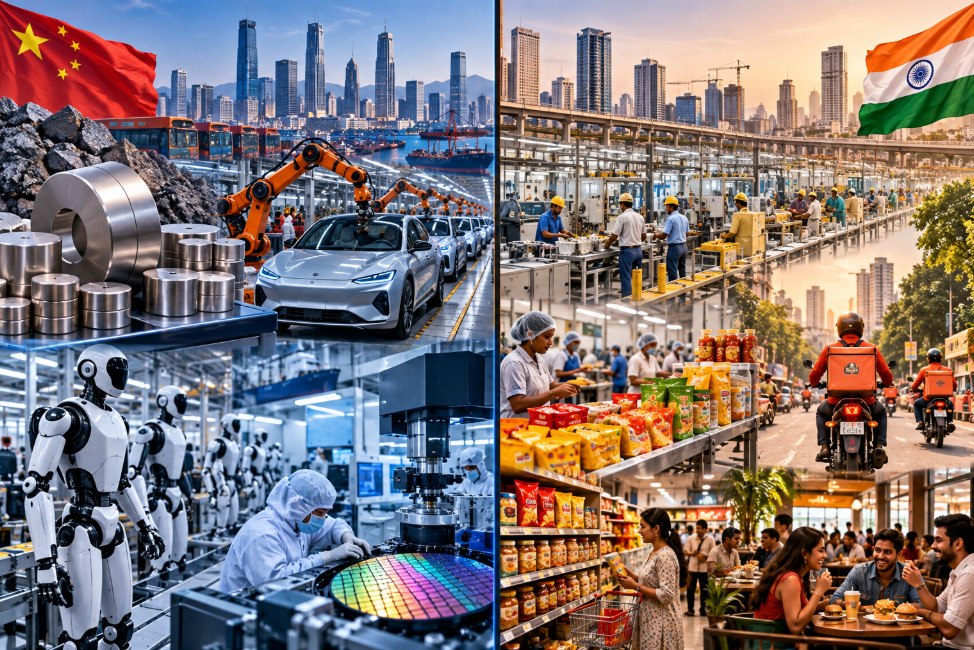
Harsh Goenka, Chairman, RPG Enterprises has raised a larger question about the future direction of Indian businesses, pointing to China’s aggressive push into industries such as rare earths, electric vehicles, robotics, semiconductors and advanced manufacturing.
In a post on X, Goenka said China was building dominance in industries that could define the next 20 years, while questioning whether Indian businesses were focusing enough on technologies and capabilities that the world would need in the future.
“China is building dominance in the industries that will define the next 20 years,” Goenka wrote, listing rare earths, magnets, batteries, EVs, robotics, semiconductors and advanced manufacturing.
His post highlighted Chinese company JL MAG as an example of this strategy. According to Goenka, the company has built a strong position in high performance rare earth magnets and is expanding into components for humanoid robots.
From raw materials to the entire ecosystem
Goenka’s larger point was about controlling the entire industrial value chain.
“The strategy is simple: own the raw material, the technology, the manufacturing and eventually the entire ecosystem,” he said.
This approach is particularly relevant for industries such as electric vehicles, batteries, robotics and semiconductors, where access to critical raw materials, manufacturing capabilities and technology can determine how much value a country captures.
China has been building capabilities across several of these areas, including rare earth processing and permanent magnets, which are important inputs for EVs, wind turbines, industrial motors, air conditioners and robotics. JL MAG, cited by Goenka, had annual production capacity of around 40,000 tonnes by the end of 2025 and is expanding this further.
Goenka’s question for Indian businesses
Goenka contrasted this long term industrial strategy with what he described as the sectors attracting significant attention from Indian businesses. He pointed to areas such as bottled water, ice creams, snacks, packaged foods and instant delivery. He also questioned India’s dependence on the software services model, arguing that a significant part of India’s software success was built around labour cost arbitrage.
His central question was therefore not simply about China. “China is building tomorrow’s infrastructure. We, in India, should be asking: what are we building that the world will need tomorrow?” he wrote.
Why the rare earth debate matters
Rare earths and permanent magnets have become strategically important because they are used across several emerging technologies. High performance magnets are required in electric vehicle motors, wind power equipment, industrial machinery and robotics. This means control over the supply chain can have implications far beyond the mining of minerals itself.
For India, the issue is particularly relevant as the country seeks to expand electric mobility, renewable energy, electronics manufacturing, defence technology and semiconductor capabilities. The challenge is moving beyond assembling products to developing capabilities across the value chain, from critical minerals and components to technology, manufacturing and intellectual property.
A broader question for India Inc
Goenka’s post comes at a time when India’s manufacturing and technology ambitions are expanding rapidly. The country is attracting investments in electronics, semiconductors, data centres, renewable energy and electric vehicles. The question raised by the RPG chairman is therefore about the next stage of this transformation: whether Indian companies can build globally competitive businesses in the technologies and industrial sectors that are likely to drive the next cycle of economic growth.
The debate is ultimately less about bottled water or ice cream and more about where capital, entrepreneurship and corporate ambition are directed. As Goenka put it, the question India needs to ask is simple: what are we building today that the world will need tomorrow?


