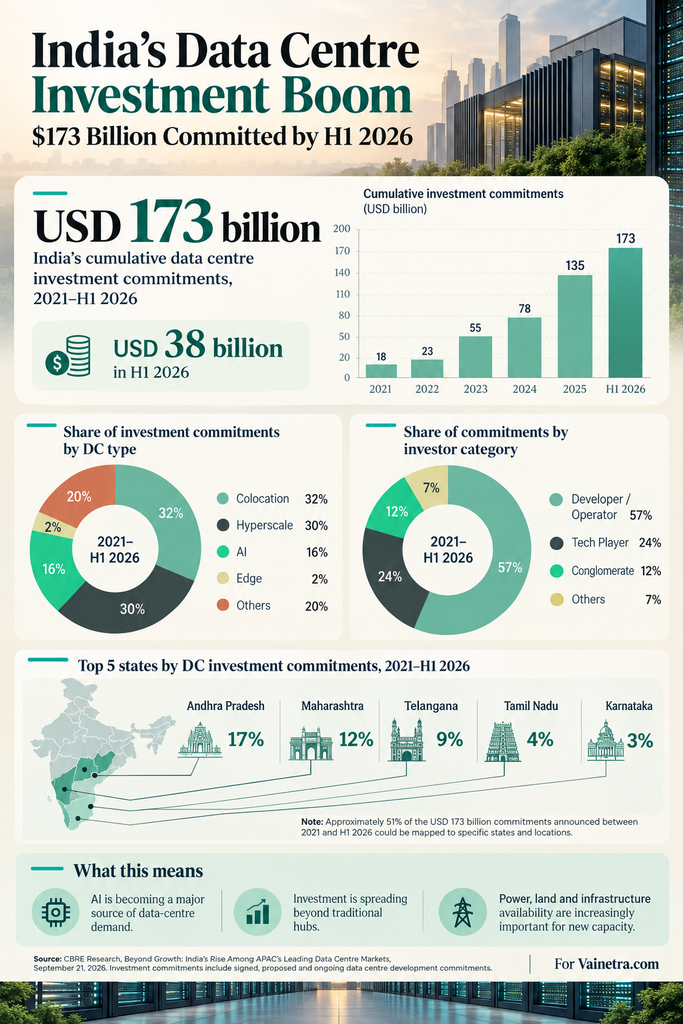
India’s data centre industry is entering a new phase of expansion, with cumulative investment commitments reaching about $173 billion since 2021. Around $38 billion was added in the first half of 2026 alone, as cloud adoption, artificial intelligence workloads and the country’s broader digitalisation push fuel demand for computing infrastructure.
India’s data centre opportunity is no longer limited to a handful of established hubs. While Mumbai, Chennai and Delhi NCR continue to account for a significant share of the country’s operational capacity, investment commitments are increasingly spreading across multiple cities and emerging markets.
According to a September 2026 report by CBRE Research, India attracted approximately $38 billion in data centre investment commitments during January to June 2026, taking cumulative commitments since 2021 to around $173 billion. The commitments considered by CBRE include signed, proposed and ongoing data centre development commitments.
The pace of commitments has accelerated sharply. CBRE’s data shows cumulative commitments rising from $18 billion in 2021 to $23 billion in 2022, $55 billion in 2023, $78 billion in 2024, $135 billion in 2025 and $173 billion by H1 2026.
Where is the money going?
The investment story is increasingly becoming a multi location story. Between 2021 and 2023, multi city portfolios accounted for more than 60% of total commitments in most years, alongside investments in established markets such as Mumbai, Delhi NCR, Bengaluru and Chennai.
But the pattern changed in 2024 and 2025. Hyderabad accounted for 23% of total commitments in 2024 and 15% in 2025, according to CBRE. Tier II cities also attracted a larger share, accounting for 16% in 2024 and 27% in 2025.
By H1 2026, the multi city category had regained prominence, accounting for more than 85% of total commitments, while single city allocations contracted.
This suggests that investors and operators are increasingly looking beyond a single data centre market and building portfolios across multiple locations.
Andhra Pradesh emerges as a major investment destination
Among the states where CBRE could map investment commitments, Andhra Pradesh accounted for the largest share at 17%, followed by Maharashtra at 12% and Telangana at 9%.
Tamil Nadu accounted for 4% and Karnataka 3%. However, there is an important caveat. CBRE says only around 51% of the $173 billion in investment commitments announced between 2021 and H1 2026 could be mapped to specific states and locations. Therefore, the state level shares do not represent the entire investment pool.
This also means that the headline $173 billion should be viewed as a measure of announced investment commitments rather than capital already deployed. Hyperscale and AI are driving the investment
The composition of investments shows that the expansion is being driven by multiple types of data centre infrastructure. CBRE’s data for 2021 to H1 2026 divides commitments across colocation, hyperscale, AI, edge and other data centre categories. Colocation and hyperscale account for the largest portions of the investment mix, while AI has also emerged as a distinct component of the pipeline.
The growing importance of AI is visible in the expansion plans of operators. CBRE’s preliminary 2026 India Data Centre Operator Survey found that 92% of surveyed operators plan to add more than 100 MW of capacity over the next 24 months. Of these, 75% indicated plans for additions of more than 250 MW, while 17% planned additions of 100 to 250 MW.
CBRE also notes that nearly $48 billion of commitments have been made for hyperscale developments since 2021. More than half of these commitments originate from leading data centre developers and operators.
Developers remain the biggest source of capital
Data centre developers and operators are also the largest investor category. For the 2021 to H1 2026 period, developers and operators accounted for 57% of commitments, according to CBRE. Technology players accounted for 24%, conglomerates for 12% and other investors for 7%.
The report also highlights the growing role of new capital and ownership structures. While institutional joint venture platforms remain dominant, public listings are emerging as another avenue for raising capital, while AI linked capital is beginning to enter the sector through strategic co investments.
Domestic investors dominate
India is also attracting substantial domestic capital into data centres. CBRE says domestic investors have accounted for the largest share of cumulative capital commitments since 2021, ahead of international investors from markets including the US, Australia, Singapore, Japan and the UK.
This is significant because data centres require large upfront investments in land, power, connectivity, cooling and computing infrastructure. The increasing participation of domestic investors points to the emergence of data centres as a significant digital infrastructure asset class in India.
Mumbai remains the operational hub
Despite the geographic diversification of future investment, India’s existing data centre capacity remains highly concentrated.
India had nearly 1,750 MW of operational data centre capacity by the end of H1 2026 following approximately 130 MW of additions during the first half of the year.
Mumbai accounted for 52% of the country’s operational data centre stock, followed by Chennai at 18% and Delhi NCR at 11%. Bengaluru accounted for 7%, Pune 8%, Hyderabad 3% and Kolkata 2%.
The concentration reflects the importance of connectivity, power, established digital ecosystems and access to customers.
But the next phase of growth could look different. CBRE expects more than 200 MW of additional supply in H2 2026, which could take India’s operational data centre capacity close to 2 GW by the end of 2026.
Why the geography is changing
The expansion into new markets is being supported by land and power availability, state incentives and improving infrastructure. CBRE expects incremental supply to extend into Hyderabad, Bengaluru, Kolkata and Visakhapatnam, while planned hyperscale developments are also highlighted in Vizag and Jamnagar.
The report also identifies state level policies and incentives as an important factor in attracting data centre investments. Maharashtra and Uttar Pradesh, among others, have introduced targeted incentives aimed at attracting investment and supporting sector growth.
AI could further broaden the data centre map
The next major driver may not simply be more cloud capacity, but the changing nature of AI workloads.
CBRE expects AI inference to become increasingly important as AI moves from model training towards real world deployment. Inference workloads require lower latency and could encourage more distributed data centre deployments closer to end users.
That could have implications for the geography of India’s data centre industry.
Instead of concentrating all computing capacity in a few large hubs, operators could increasingly need infrastructure distributed across multiple markets to support latency sensitive AI applications.
For India, therefore, the $173 billion investment commitment pipeline is not simply about building more data centres. It represents a shift towards a broader digital infrastructure network spanning established hubs, emerging cities, hyperscale campuses and AI focused facilities.
With $38 billion of commitments already added in the first six months of 2026, the next phase of India’s data centre boom could increasingly be defined not by how much capacity the country builds, but by where that capacity is located and what workloads it is designed to serve.