Artificial intelligence is no longer sitting on the sidelines of India’s Global Capability Centre (GCC) ecosystem. It is increasingly becoming part of the core work performed by GCCs across software, banking, healthcare, retail and engineering, with generative and agentic AI emerging as major drivers of this transformation, according to the Great Workplace Reset report by Awfis Space Solutions and Zinnov.
The report found that 52% of AI use cases in Indian GCCs had shifted to generative or agentic AI in FY26, surpassing traditional AI and machine learning for the first time. More than 1,200 GCCs had AI and machine learning capabilities, showing how deeply AI had become embedded in the GCC operating model.
The change, however, is not uniform across industries. Each sector is using AI to address different business problems, from writing software and detecting fraud to predicting clinical risks, personalising shopping and designing industrial products.
Software and Internet: AI moves into the code
Software and internet GCCs are among the biggest users of AI, with the technology increasingly embedded directly into the software development process.
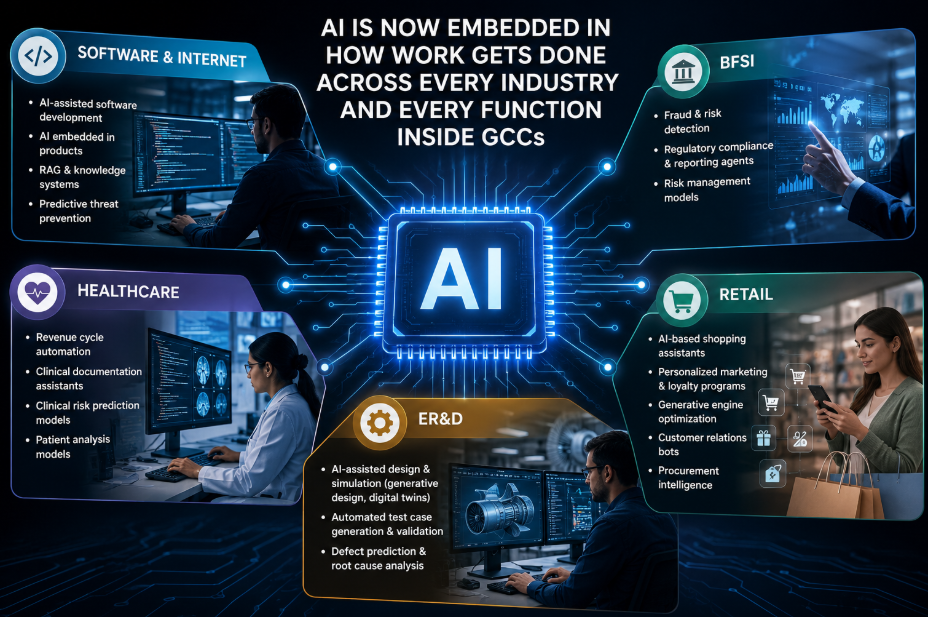
The report identifies AI assisted software development, AI embedded into software products, knowledge and retrieval augmented generation (RAG) systems, and predictive threat prevention in cybersecurity as prominent use cases.
This marks a shift from using AI simply as an efficiency tool to making it part of the products and platforms being developed from India. The report said India was increasingly becoming a build location for frontier engineering, product and platform work.
The shift is particularly significant because companies building AI capabilities place higher value work in India. AI builders allocate 9.6% of their work portfolio to “Rocket Science”, compared with 5.5% for AI adopters.
BFSI: From fraud detection to compliance agents
In banking, financial services and insurance, AI is moving deeper into risk management and regulatory functions.
The report identifies fraud and risk detection and regulatory compliance and reporting agents as key AI use cases in BFSI GCCs.
This suggests that AI’s role in financial services GCCs is moving beyond traditional analytics. Instead of merely analysing historical information, AI systems are increasingly being incorporated into processes that require continuous monitoring, decision support and automated reporting.
For global financial institutions, this also increases the strategic importance of their Indian GCC operations as they take on more complex technology and risk related mandates.
Healthcare: AI enters clinical workflows
Healthcare GCCs are using AI in areas closer to actual clinical and patient related workflows.
The report identifies revenue cycle management automation, clinical documentation assistants, clinical risk prediction models and patient analysis models among the prominent healthcare use cases.
This represents a significant expansion in the role of healthcare GCCs. AI is being used not only for back office automation but also to support processes that require analysis of large amounts of clinical and operational data.
The report’s broader conclusion is that generative and agentic AI use cases have moved into the core work of major industries rather than remaining standalone technology programmes.
Retail: AI gets closer to the consumer
Retail GCCs are using AI across both customer facing and operational functions.
The report identifies AI based shopping assistants, personalised marketing and loyalty programmes, generative engine optimisation, customer relations bots and procurement intelligence as prominent applications.
The combination of these use cases shows how AI is being deployed across the retail value chain. On the customer side, it can help companies personalise interactions and shopping experiences, while on the operational side it can support procurement and other enterprise processes.
Generative engine optimisation is also emerging as a new area, reflecting the changing way consumers discover products and information through AI powered search and recommendation systems.
ER&D: AI transforms product design and engineering
Engineering, research and development GCCs are using AI to reshape how products are designed, tested and improved.
The report identifies AI assisted design and simulation, including generative design and digital twins, automated test case generation and validation, and defect prediction and root cause analysis as prominent ER&D use cases.
The significance goes beyond automation. These applications allow GCC teams to participate in increasingly complex stages of product development, strengthening India’s role in global engineering and R&D.
This is consistent with the wider transformation in India’s GCC work portfolio. The report found that commodity and procedure based work had declined between 2015 and FY26, while higher value work had increased. Almost half of Indian GCCs had a share of frontier “Rocket Science” work equal to or higher than their headquarters.
One AI story, five different transformations
The sectorwise use cases show that there is no single AI model for India’s GCC ecosystem.
For software companies, AI is becoming a development and product engine. For BFSI, it is moving into fraud, risk and compliance. Healthcare is applying it to clinical and patient workflows. Retail is using it to transform customer engagement and procurement, while ER&D is deploying it across product design, simulation and testing.
The common thread is that AI is becoming embedded in the work itself.
“Generative and agentic use cases now sit in the core work of every major industry,” the report said. “AI has stopped being a separate programme and become part of how each function operates.”
That shift could prove more important than the headline number of AI enabled GCCs. As India’s GCC ecosystem moves from cost arbitrage towards product ownership, engineering, innovation and enterprise transformation, the real measure of India’s AI advantage may increasingly be the complexity of the work global companies are willing to entrust to their Indian centres.